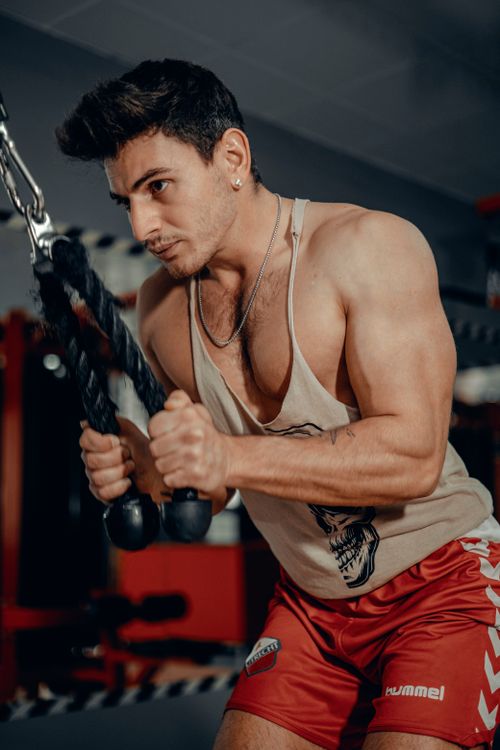
The seated dumbbell overhead triceps extension trains elbow straightening while your upper arms stay overhead. A stable seat can make the movement easier to organize, but sitting down does not automatically prevent back arching or make every weight appropriate. Start with a load you can position, lower, and put away confidently. The quality of the setup matters as much as the repetitions.
Prepare the seat and your grip
Choose a sturdy gym bench with enough clearance behind your head. If using back support, check that it does not obstruct the dumbbell's path. Plant both feet securely, sit tall, and keep your head comfortably aligned with your torso. Before picking up the weight, rehearse bending and straightening your elbows overhead. If that position already hurts, choose another exercise rather than adding resistance.
For the two-handed version, use a dumbbell whose shape allows a secure grip. Cup the underside of its upper end with both hands, keeping it vertical. Avoid equipment with loose components or an unfamiliar adjustable mechanism overhead. Ask a trainer to demonstrate the grip and the transfer into position if either feels uncertain. A weight you can move during repetitions may still be too awkward to lift safely into place.
Perform a controlled repetition
- Bring the dumbbell overhead under control. Settle your torso before starting; do not begin while the weight is still wobbling.
- Bend your elbows to lower the dumbbell behind your head. Keep the upper arms relatively steady and leave enough clearance to avoid contact with your head.
- Stop the lowering phase before you need to arch your back, push your head forward, or drag your upper arms backward. Your comfortable range is more important than reaching an arbitrary depth.
- Straighten the elbows smoothly to return overhead. Avoid snapping them into the end position. Breathe continuously, exhaling as you lift and inhaling as you lower.
The main visible motion should come from your elbows. Think of the upper arms as a stable frame rather than trying to squeeze them together as tightly as possible. If maintaining the overhead position feels like a struggle before your triceps become tired, reduce the load and have a qualified trainer check the setup.
Fix mistakes before adding weight
- Back arching: finish the set, reduce the weight, and reset your seated position. Repeatedly leaning backward changes the movement you are trying to practice.
- Chasing a deeper stretch: use a repeatable, comfortable bottom position instead of forcing the dumbbell farther down.
- Fast, uneven repetitions: slow the lowering phase enough to notice whether your elbows and torso remain steady.
- Grinding through the final repetition: stop while you can still return the weight safely. Plan the exit before the set, not after your arms are exhausted.
A beginner practice example
One possible starting session is a very light rehearsal set followed by one or two sets of 10 to 12 controlled repetitions, resting around 90 seconds between sets. This is an illustrative practice plan, not a universal prescription. Choose a weight that leaves a few comfortable repetitions available, and consider the pressing and other triceps work already in your routine.
Record the dumbbell weight, repetitions, and whether the final repetition looked like the first. When the whole set becomes comfortable across several sessions, try the smallest available increase. If the heavier dumbbell makes the transfer overhead awkward or shortens your controlled range, return to the previous load.
Comfort and safety
Stop for elbow, shoulder, or neck pain rather than treating it as a necessary training sensation. Persistent symptoms or an existing injury deserve individualized guidance. An overhead extension is an option, not a requirement for building stronger arms.
Sources and their scope
- ACE: Dumbbell triceps extension technique describes a standing version; its elbow-motion and control cues inform this seated adaptation.
- PureGym: Overhead triceps extension guide covers the two-handed grip and seated or standing options.
- Mayo Clinic: Weight-training technique and safety supports gradual loading, controlled movement, and stopping for pain, rather than the specific sample workout.
تعليقات
إرسال تعليق