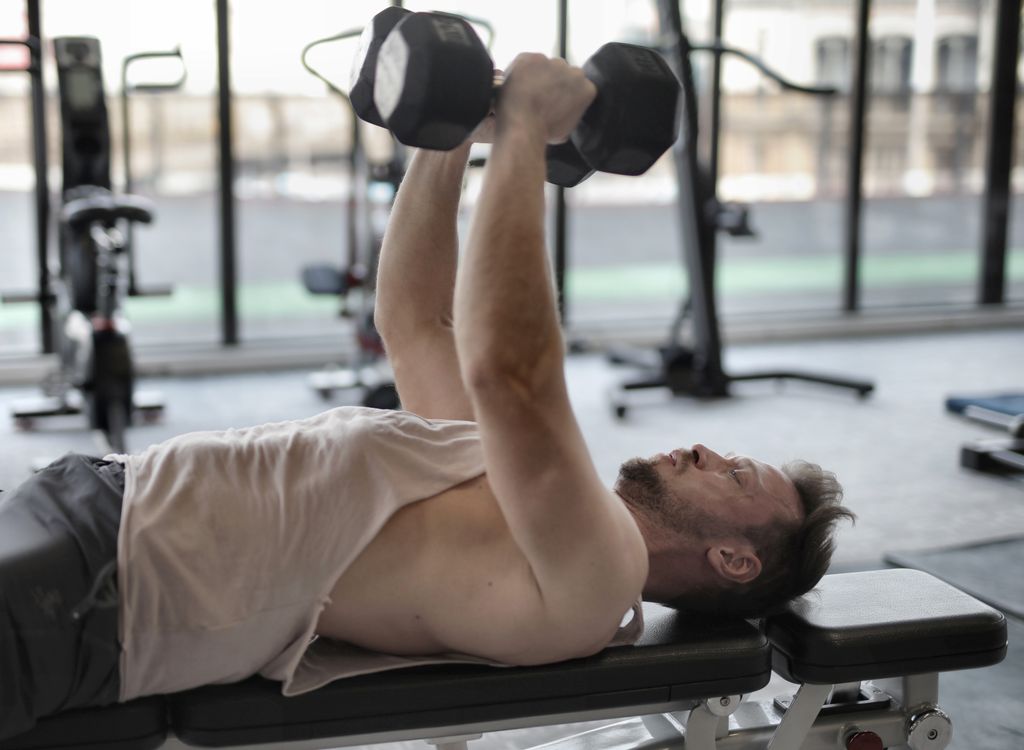
The incline dumbbell chest press gives you a repeatable way to practise pressing with each hand holding its own weight. Your chest, front shoulders and triceps contribute to the movement. For a beginner, the useful goal is a stable setup and matching repetitions, rather than choosing the largest dumbbells available. Treat the first few sessions as practice: learn where the bench belongs, how the weights travel and how to finish safely.
Choose a bench position you can repeat
Check that the bench adjustment is fully engaged before picking up the weights. A 45-degree backrest is a reasonable starting example, not a required angle for every lifter. ACE demonstrates the exercise at 45–60 degrees. NASM also uses 45 degrees in its single-arm variation and notes that a steeper position shifts more emphasis toward the front shoulders. Record your setting so comparisons between workouts remain meaningful.
Choose dumbbells you can position without a struggle. Before starting, clear the space beside the bench and decide how you will finish the set. If getting into position is unfamiliar, ask a qualified trainer to demonstrate it with light weights. Do not make your first attempt with a weight that already requires help.
Perform a controlled repetition
- Lie back with your head, upper back and hips supported. Plant your feet securely, using a suitable stable platform if necessary.
- Set your shoulders gently down and back. Hold the handles with your thumbs wrapped around them and wrists aligned with your forearms.
- Start with the dumbbells supported above your upper chest. Lower both together, keeping your elbows beneath your wrists.
- Use a comfortable depth that does not force your shoulders forward or produce pain. Avoid bouncing the weights against your chest.
- Breathe out as you press upward. Finish smoothly, without striking the dumbbells together, then begin another controlled descent.
Think of each repetition as a short repeatable route. The last repetition should follow approximately the same route as the first. If one weight suddenly takes a different path, end the set rather than chasing a predetermined number. When using a spotter, agree on a clear request for assistance before starting.
Common problems to notice
- Changing the bench angle between sessions without recording it makes progress harder to interpret.
- Turning a difficult repetition into a large back arch changes the movement you intended to practise.
- Letting the wrists fold backward can make the weights feel less secure.
- Rushing the descent removes an opportunity to check whether both sides remain controlled.
- Adding repetitions after technique deteriorates turns a useful training target into an unnecessary challenge.
A beginner practice example
After a general warm-up and a light rehearsal set, one possible starting session is two sets of 8–12 repetitions with about two minutes between sets. Choose a load that leaves room for approximately two or three additional controlled repetitions. This is an illustrative training example, not a universal prescription. Your experience, other exercises and recovery may call for less work.
Keep a short record: bench setting, dumbbell weight, repetitions and any setup difficulty. Suppose you complete 10 repetitions in the first set and nine in the second. At the next session, aim to make those repetitions more consistent before increasing weight. Once both sets reach 12 with the same control across repeated sessions, consider the smallest available increase. Return to fewer repetitions if needed.
Safety and sources
Stop if the exercise causes pain. Persistent discomfort or an existing shoulder problem deserves individual assessment rather than another technique cue. The following resources support the movement and general safety guidance; they do not validate the sample workout as suitable for everyone.
- ACE: Incline Chest Press covers the two-arm setup, wrist alignment, movement and spotting.
- NASM: Single-Arm Incline Dumbbell Chest Press provides related bench-angle and muscle information; its unilateral exercise differs from this two-arm guide.
- Mayo Clinic: Weight-training technique supports warming up, manageable loading, breathing and stopping for pain.
تعليقات
إرسال تعليق